A practical guide to bedroom furniture
Platform Bed Frames: How Slats, Height, and Assembly Shape Everyday Use
A platform bed can look beautifully simple. What matters beneath the mattress, though, is a set of practical details: the slats, the frame’s support system, its height, and the way its parts come together. Understanding those features can help you choose a hardwood bed frame that suits your mattress, your room, and the routines of everyday life.
Published November 2, 2026
The details that make a platform bed work
Platform bed frames appeal for an uncomplicated reason: they bring mattress support and bedroom furniture together in one considered design. Many platform frames use a slatted base, so a separate box spring may not be needed. But “platform” describes a general type of bed, not a guarantee that every frame will suit every mattress or every bedroom.
Slat spacing, the way the slats attach, the presence of center support, and the overall frame height all affect how the bed functions once it is in place. Assembly matters, too. A sturdy frame depends not just on its material, but on how rails, hardware, and support pieces connect.
That makes the most useful comparison a practical one. Before choosing a silhouette or wood tone, consider what the mattress manufacturer requires, how much room you have, what you want to store beneath the bed, and whether you are comfortable assembling the frame. These questions are especially important for larger bed sizes, where a design may include additional support components.
Start with the mattress and its support requirements
A platform frame should be compatible with the mattress placed on it. Mattress makers may specify a particular foundation type, maximum distance between slats, or other support conditions. Those instructions can vary by mattress construction, so check the documentation for your exact mattress rather than relying on a general rule about all foam, hybrid, or innerspring models.
The frame’s product information is the other half of the compatibility check. Look for the dimensions of the sleeping surface, the spacing between slats, and any guidance about mattress type or foundation use. If the listing does not give enough detail, ask the manufacturer or retailer before committing. A clear answer is more useful than assuming that a platform design automatically meets every requirement.
Also consider whether you want the option of using a box spring. Some platform beds are designed to support a mattress directly, while a manufacturer may offer a version configured for use with a box spring. The two arrangements can change the height of the sleeping surface, so it is worth clarifying the intended setup when comparing models.
Slat spacing: a small measurement with a big role
Slats are the crosswise supports beneath the mattress. They carry its load and help distribute weight across the frame. The distance between them matters because the mattress needs appropriate support across its surface. Wider gaps are not automatically a problem, nor are closely spaced slats automatically the right choice: the relevant measure is the one permitted by your mattress manufacturer and supported by the bed’s design.
When reviewing a bed frame, look for more than a general mention of “slats.” Useful questions include:
- How many slats are included, and how are they positioned?
- What is the approximate gap between the slats?
- Do the slats rest on the side rails, fit into locating points, or attach in another way?
- Does the frame include additional support beneath the slatted area?
- Are there special instructions for larger sizes?
Some Maple Corner Woodworks bed descriptions, for example, specify ten wide hardwood slats that interlock with hardwood dowels on the side rails. That is a more useful starting point than an unspecified claim about a “strong base,” but the number of slats alone does not tell you their spacing or whether they meet a particular mattress warranty. Confirm the measurements against the mattress maker’s guidance.
A slat system should also remain properly seated during normal use. A slat that shifts or lifts can create an uneven foundation and an unwelcome rattle. Ask how the slats are retained and whether the manufacturer provides setup or maintenance instructions. The connection details may be less visible than the headboard, but they are part of the bed’s everyday performance.
Center support and the realities of larger sizes
As bed size increases, the support system deserves a closer look. A larger frame spans a wider area, and its construction may include a reinforced center section or other support features. The precise design depends on the bed, so do not assume that every king or California king frame uses the same arrangement.
Check the product details for the size-specific support plan. Does the frame add a center rail, reinforced beam, or another component? If a center support is included, does it rest on the floor, attach to the head and foot sections, or use a different connection? These are not merely technical curiosities. They help you understand how the frame is assembled and what the manufacturer intends to carry the load.
Some Maple Corner Woodworks descriptions state that king and California king versions use a reinforced hardwood support beneath the slats, attached to the head and foot boards with drop-in hardware. The described design does not require a center leg. That detail belongs to the listed bed designs; it should not be generalized to all platform frames. When considering a specific model, confirm the support configuration for the exact size you plan to order.
It is equally important to follow the manufacturer’s stated weight limits and assembly directions, if provided. A bed’s solid-wood construction may be reassuring, but material alone does not replace information about load capacity, support placement, and correct installation.
Frame height: comfort, clearance, and room proportions
Bed height changes how a bedroom feels and functions. The finished height is not just the height of the frame: it includes the mattress, and possibly a foundation if the chosen setup uses one. A low platform can create a grounded, minimal look, while a taller bed may make it easier for some people to sit down or stand up. Personal comfort, mobility, and the mattress’s thickness all play a part.
Before choosing, measure the complete arrangement rather than judging from a photograph. If you can, use painter’s tape or a simple measurement on the wall to picture where the top of the mattress will sit. Consider the relationship to nearby nightstands, window sills, and the room’s overall proportions. A particularly thick mattress on a tall frame can change the visual balance; a low frame paired with a thin mattress may sit lower than expected.
Under-bed clearance is another everyday consideration. If you plan to store bins, luggage, or seasonal bedding beneath the frame, check the clearance from floor to the lowest obstruction, not just the listed frame height. A support rail or center component may affect usable space. If cleaning access matters, consider whether the frame leaves enough room for your vacuum or other cleaning method.
Some hardwood platform beds are designed without a center leg, which may leave the space below more open. That can be convenient, but confirm the specific frame’s construction and the available clearance rather than assuming all platform designs offer the same access. A photo or general description may not answer whether a container will fit beneath the rails.
Assembly: how connections influence confidence
Assembly is part of the experience of owning a bed. A frame may use rails and hangers, drop-in hardware, bolts, or other connections. The setup method affects how many tools are needed, how many people may be useful during installation, and how straightforward it is to take the bed apart if you move.
Read the assembly description before ordering. Check whether the frame is delivered in sections, whether hardware is included, and whether the manufacturer recommends a particular sequence. If the product description says no tools are required, confirm whether that applies to the entire assembly or only to a stated connection. Keep the instructions accessible, and do not substitute different hardware or skip components in an effort to speed up the process.
Maple Corner Woodworks bed descriptions state that side rails connect to the head and footboards with heavy-duty cast hangers and that assembly requires no tools. The descriptions also refer to slats that interlock with dowels. Together, these details offer a sense of how the frame is intended to come together. Still, the specific instructions supplied with the bed should be treated as authoritative, especially if the frame has size-dependent support parts.
A careful setup can prevent avoidable problems. Assemble the bed on a level surface, check that rails and supports are seated as instructed, and verify that each connection is secure before placing the mattress. If something does not align, pause and consult the instructions or the maker rather than forcing a joint. A well-designed connection is only dependable when it is correctly engaged.
Hardwood, joinery, and the character of the frame
Solid hardwood brings visible grain, natural variation, and a substantial presence to a bedroom. It can also be crafted into a range of styles, from the spare lines of a Shaker-inspired bed to a more contemporary platform profile. Wood species influence appearance, but the frame’s construction and finish are just as relevant to long-term satisfaction.
Look for specific descriptions rather than relying on broad labels. “Hardwood” does not identify a species, and “handcrafted” alone does not explain how the parts are joined. Product details may identify available woods, finish type, place of manufacture, or distinctive construction features. If these points matter to you, ask for clarification where a listing is incomplete.
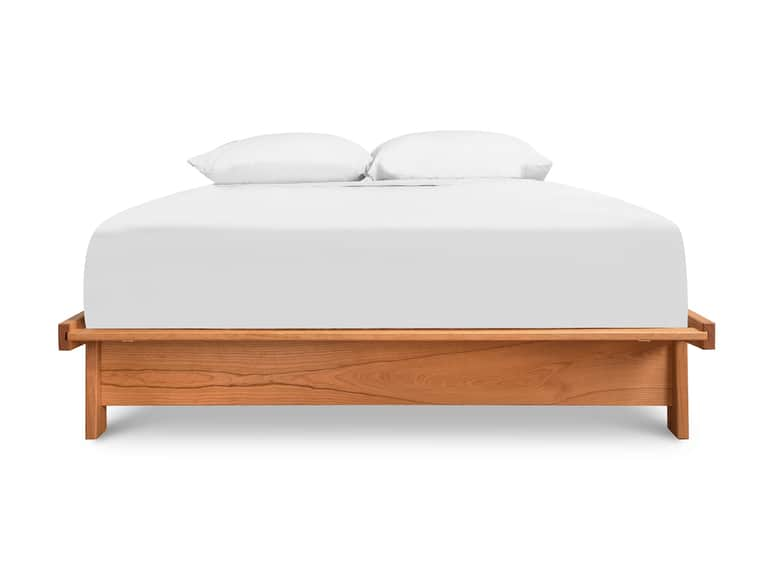
The Cherry Moon Dovetail Platform Bed is described as a made-to-order platform bed crafted in Vermont from solid, sustainably harvested woods and finished with an eco-friendly oil. Its listing emphasizes a simple modern profile and durable construction. For a comparison, focus on the concrete information available: wood sourcing, finish, construction description, and the support specifications you will need to confirm for your mattress.
Finish affects both the look and the care routine. An oil finish can bring attention to the wood’s natural character, but care instructions differ by product. Follow the maker’s guidance for cleaning and maintenance, and avoid applying household cleaners or additional coatings unless they are recommended. A little attention to the finish can help preserve the frame’s appearance without turning routine care into a complicated project.
A room-by-room fit check before you decide
A bed frame can be beautifully made and still be the wrong fit for a particular room. A few measurements and practical questions help make the choice feel more considered:
- Measure the room: Account for the bed’s full outside dimensions, not only the mattress size. Leave space for drawers, doors, and comfortable paths around the bed.
- Check access: Measure stairways, hallways, doorways, and turns between the delivery point and bedroom. Ask how the frame ships and whether it arrives in manageable sections.
- Plan the finished height: Add the frame, mattress, and any foundation height. Compare the result with bedside tables and your preferred sitting position.
- Confirm storage needs: Measure the height and width of anything you hope to store beneath the bed, then check the actual clearance and support layout.
- Match support to the mattress: Compare slat spacing and foundation requirements with the mattress maker’s written instructions.
- Review assembly: Understand the hardware, tools, and support components involved before delivery day.
These checks are especially useful for made-to-order furniture. A frame made from natural hardwood may have grain and color variation, and a custom or handcrafted order may involve a production timeline. Make sure the dimensions, finish, wood selection, and assembly arrangement are understood before confirming your choice.
Common comparison mistakes to avoid
One frequent mistake is choosing by appearance alone. A tapered leg or clean-lined headboard may win attention, but neither tells you how the slats are spaced or what happens beneath a larger mattress. Keep the visual preferences, then test them against the functional details.
Another is treating “platform” as shorthand for “no box spring needed in every circumstance.” Many platform beds support a mattress directly, but the correct setup depends on the specific frame and mattress. Confirm both sets of instructions. A mismatch could affect comfort, support, or warranty coverage.
It is also easy to confuse a frame’s overall height with its under-bed clearance. The rail height, slat position, and support components all matter. If storage is a priority, request the specific clearance measurement instead of estimating from a lifestyle photograph.
Finally, do not treat vague construction language as a substitute for answers. If you cannot find the slat spacing, size-specific center support, or assembly method, ask. Good questions are part of choosing a bed responsibly—not evidence that you are overthinking a piece of furniture you will use every day.
A calm, confident checklist
Before settling on a platform bed frame, make sure you can answer these questions:
- Does the frame support the mattress type I own, according to the mattress manufacturer?
- What are the slat spacing and attachment details?
- How is the larger size supported, if I am choosing a queen, king, or California king?
- What will the finished bed height be with my mattress?
- How much usable clearance will remain beneath the frame?
- What hardware and tools are needed for assembly?
- What are the frame’s outside dimensions, delivery format, and care instructions?
When those answers line up with your room and mattress, the design becomes more than a good-looking silhouette. It becomes a practical foundation for daily life—one that supports a restful bedroom, fits the space you have, and makes sense from the first assembly step onward.